RSI
Type: Momentum oscillator
Best for: Overbought / oversold context
Strength: Fast momentum reading
Limitation: Can stay extreme in strong trends
 Consensus Engine
RSI and MACD are two of the most widely used crypto trading indicators, but they do different jobs. This guide explains how each one works, what each one helps with, and why many traders compare both instead of relying on one alone.
RSI is mainly used as a momentum oscillator, while MACD is often used to track momentum shifts and trend-related changes. They are related, but they are not interchangeable.
Because they measure different aspects of price behavior, many traders use RSI and MACD together to get a more complete market view.
Type: Momentum oscillator
Best for: Overbought / oversold context
Strength: Fast momentum reading
Limitation: Can stay extreme in strong trends
Type: Trend and momentum indicator
Best for: Momentum shifts and trend confirmation
Strength: Helps identify directional transitions
Limitation: Can react later than price
RSI helps traders evaluate momentum and whether a move may be stretched. It is commonly used to spot overbought or oversold conditions, divergence, and momentum weakening.
Its main limitation is that it can remain elevated or depressed for a long time in strong trends, which means extreme readings alone are not always enough.
MACD helps traders identify momentum transitions by comparing moving averages. It is often used to evaluate whether directional strength is increasing, decreasing, or shifting.
Its limitation is that it is still derived from lagging averages, so part of a move may already be underway before the signal becomes obvious.
There is no universal winner because each indicator answers a different question. RSI is often better for quick momentum context, while MACD is often better for broader momentum shifts and trend-related confirmation.
That is why many traders do not treat it as RSI versus MACD in a strict sense. Instead, they compare both and look for agreement.
Using multiple indicators can help reduce incomplete readings. RSI may highlight stretched momentum, while MACD may help confirm whether the broader move is strengthening or fading.
When several indicators align instead of conflicting, traders get a clearer picture than they would from one indicator alone. For a broader workflow, see how to combine crypto indicators, review the crypto consensus indicator, or explore the crypto indicator dashboard.
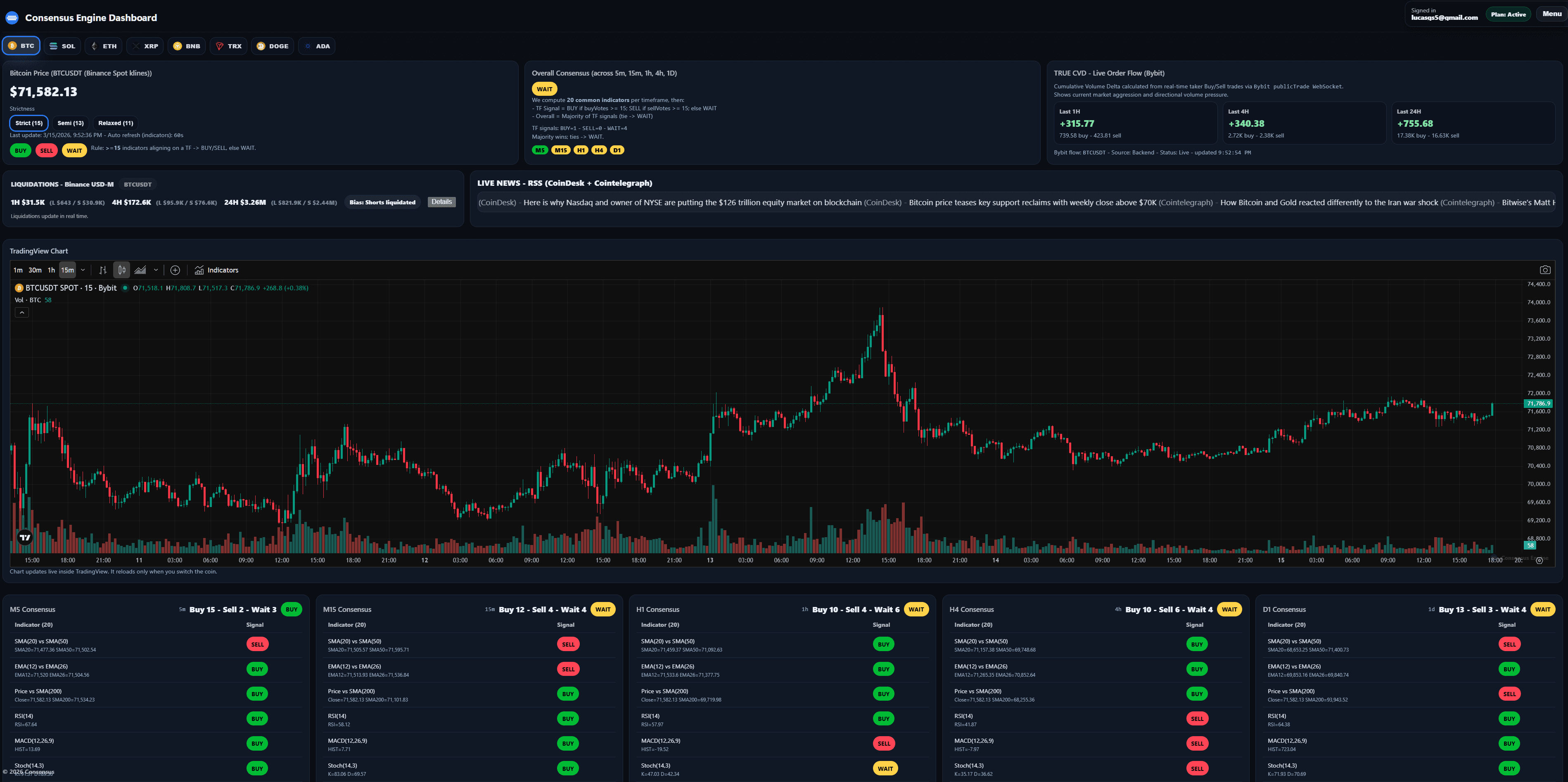
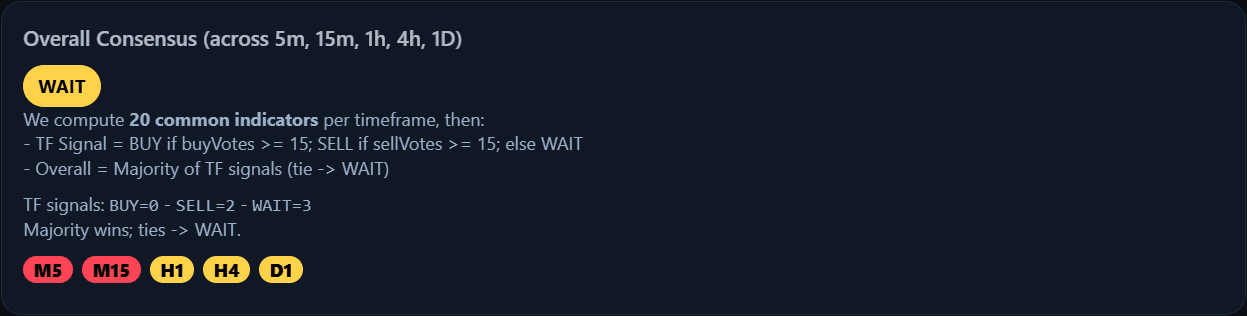
Consensus Engine is built for this exact problem. Instead of forcing traders to compare RSI, MACD, and other signals one by one, the dashboard organizes 20 indicators across 5 timeframes into one structured market view.
That makes it easier to evaluate agreement, conflict, and confirmation without jumping between multiple charts and tools.
Keep different signal types together so agreement, conflict, and confirmation are easier to read.
Compare short-term movement with broader structure across M5, M15, H1, H4, and D1 in one workflow.
Use TRUE CVD when you want another read on whether participation is supporting the move.
Neither is universally better. RSI and MACD measure different aspects of the market, which is why many traders compare both.
Yes. Many traders use RSI and MACD together because they provide different but complementary information.
RSI often reacts faster to short-term momentum changes, while MACD is often used for broader momentum shifts and trend-related confirmation.
Yes. The Quick Preview shows a limited blurred view with a short live preview of the selected crypto.
Consensus Engine helps traders organize RSI, MACD, and many other signals into one clean dashboard.
Start with the broader guide to indicator categories, use cases, and limitations.
Review the indicator types traders compare most often when building a market view.
See how traders use different indicator roles together instead of relying on one signal.
Learn how Consensus Engine summarizes multiple technical readings into a structured view.
Explore the main product guide for the dashboard that organizes alignment across signals and timeframes.