Trend indicators
Trend indicators help traders understand whether the market is moving with directional strength or drifting sideways.
Examples: Moving averages, MACD
 Consensus Engine
Crypto indicators help traders interpret price action, momentum, volatility, and participation. This guide explains the main types of indicators used in crypto trading and why many traders combine them instead of relying on one signal alone.
Crypto indicators are tools derived from market data such as price, volume, and volatility. Traders use them to better understand trend direction, momentum strength, market conditions, and confirmation.
No indicator is perfect on its own. Each one reveals a different part of the picture, which is why many traders compare multiple indicators before acting. If you want a broader overview of the combinations traders often use in practice, the best crypto indicators guide goes deeper.
Trend indicators help traders understand whether the market is moving with directional strength or drifting sideways.
Examples: Moving averages, MACD
Momentum indicators help measure how strong a move is and whether buying or selling pressure may be stretched.
Examples: RSI, Stochastic RSI
Volatility indicators help traders understand whether the market is expanding, contracting, or moving toward extremes.
Examples: Bollinger Bands, ATR
Participation indicators help confirm whether price movement is supported by activity and market involvement.
Examples: Volume, order flow, CVD-style confirmation
What it is: Moving averages smooth price data over time to help traders identify broader direction.
What it helps with: They can help show whether price is trading with or against the prevailing trend.
One limitation: Because they are lagging, they may react after a move is already underway.
What it is: The Relative Strength Index is a momentum indicator often used to identify overbought and oversold conditions.
What it helps with: It can help traders judge whether momentum is strong, stretched, or weakening.
One limitation: In strong trends, RSI can remain elevated or depressed longer than expected.
What it is: MACD compares moving averages to highlight momentum shifts and possible changes in directional strength.
What it helps with: It can help confirm trend transitions and momentum changes.
One limitation: It may confirm part of a move after it has already started.
What it is: Stochastic RSI is a more sensitive momentum tool derived from RSI.
What it helps with: It can help traders spot short-term momentum swings.
One limitation: Its sensitivity can produce more noise and false reactions.
What it is: Bollinger Bands place price inside volatility bands around a moving average.
What it helps with: They can help traders understand volatility expansion, contraction, and relative price extremes.
One limitation: A touch of the band alone does not confirm reversal or continuation.
What it is: Participation-based tools evaluate whether price movement is supported by real market activity.
What it helps with: They can help confirm breakouts, trend continuation, and stronger directional moves.
One limitation: Participation alone is not enough without price structure and context.
What it is: Multi-timeframe analysis compares lower and higher timeframe conditions to see whether the market is aligned.
What it helps with: It can help traders avoid taking setups that look strong on one timeframe but weak on another.
One limitation: Different timeframes can conflict, which makes organization important.
Most traders do not rely on a single indicator because no single tool consistently explains everything happening in the market.
Trend, momentum, volatility, participation, and timeframe context each add a different layer of information. Combining them can create a clearer view, as long as the signals are organized in a useful way.
A common mistake is stacking more and more indicators without a clear process. More indicators do not automatically improve decision quality.
What matters is whether those signals can be read together. The real advantage comes from understanding how different signals align, conflict, or confirm each other.
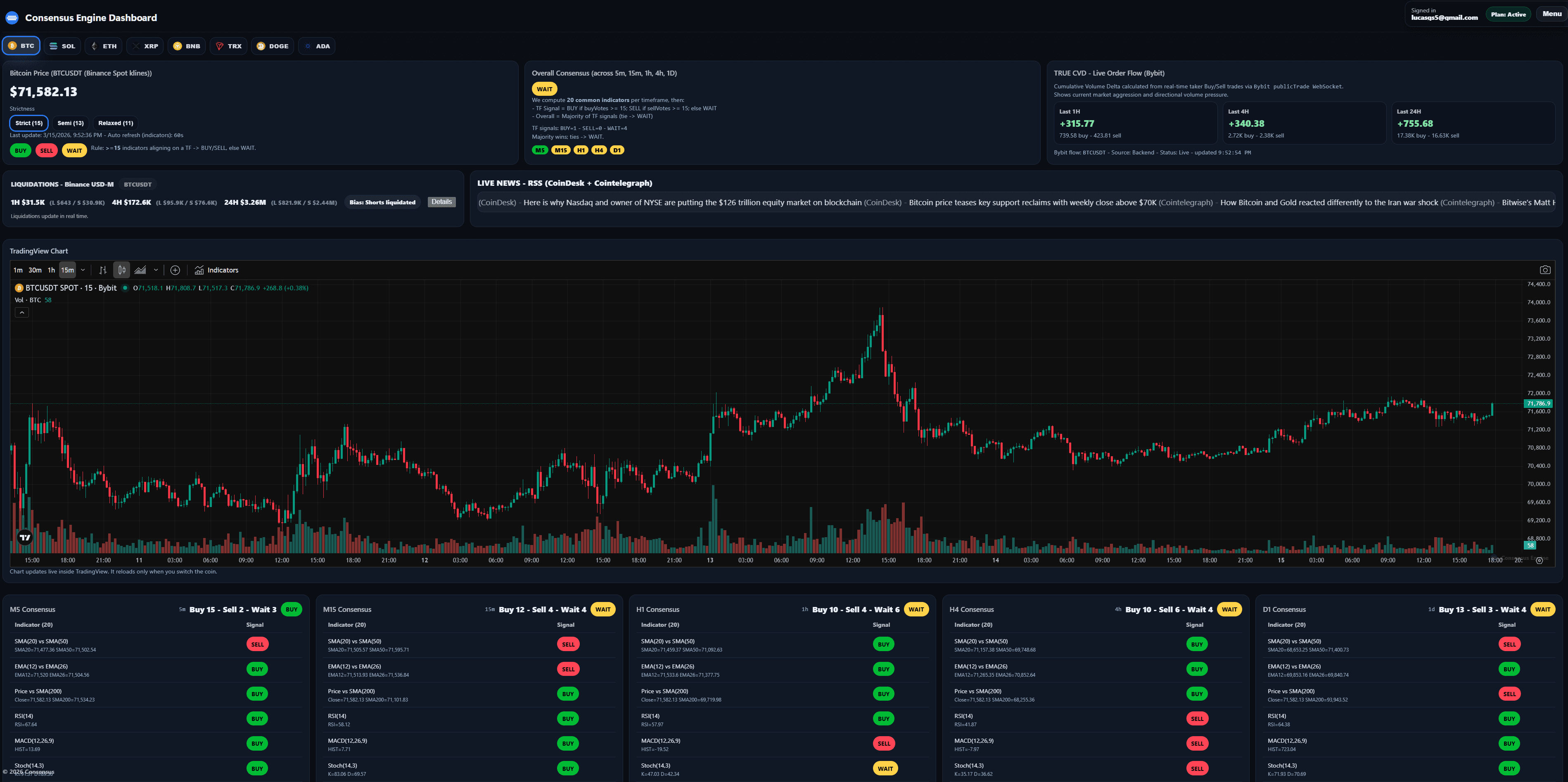
Consensus Engine is built around this exact problem. Instead of forcing traders to manually compare isolated signals, the dashboard organizes 20 indicators across 5 timeframes into one structured market view.
That makes it easier to evaluate trend, momentum, participation, and context without jumping between multiple charts and separate tools. You can explore the main crypto indicator dashboard, learn how the crypto consensus indicator summarizes signals, or review the multi-timeframe trading dashboard workflow.
Consensus Engine keeps a broad signal set together so traders can compare trend, momentum, and confirmation without jumping between separate tools.
M5, M15, H1, H4, and D1 stay visible together, which helps traders compare short-term movement with broader structure.
TRUE CVD adds a participation layer when traders want another read on whether the move is being supported by market activity.
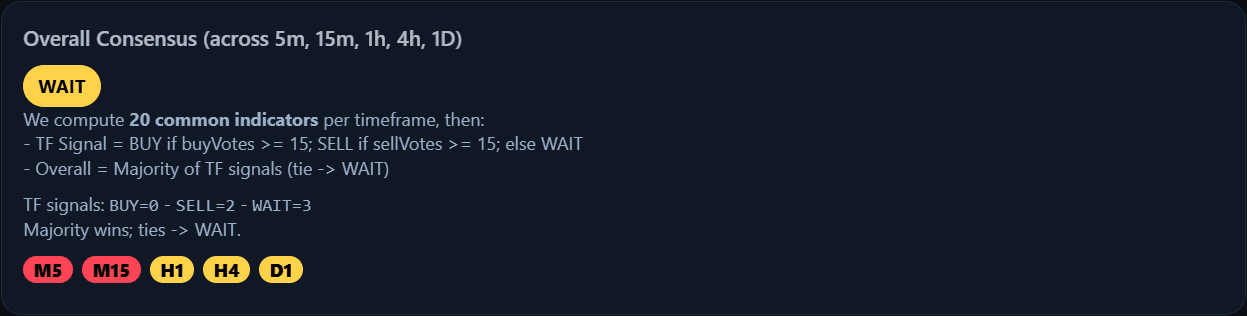
The consensus panel helps traders see whether multiple readings are aligned or still mixed.
The indicator panels make it easier to compare underlying readings without checking each tool separately.
Some of the most common crypto indicators include moving averages, RSI, MACD, Bollinger Bands, and volume-based confirmation tools.
There is no single best indicator for every market condition. Different indicators help with different types of analysis, which is why many traders combine them.
Combining indicators can help reduce noise and improve decision context when several signals support the same market view.
Yes. The Quick Preview shows a limited blurred view with a short live preview of the selected crypto.
Consensus Engine helps traders compare multiple indicators, multiple timeframes, and market context in one clean dashboard.
Read a more focused guide on the indicator types traders compare most often.
See how the product organizes multiple indicators and timeframes into one workflow.
Explore how the same workflow applies specifically to BTC market structure.
Review how lower and higher timeframes can be compared inside one market view.
Learn how multiple technical readings can be summarized into a clearer view.
See how alignment, confirmation, and context fit together in a signal workflow.