Type
Volatility indicator
 Consensus Engine
ATR, or Average True Range, is a volatility indicator used to estimate how much price typically moves over a period.
Volatility indicator
Risk sizing and stop placement
Helps quantify typical movement size
Does not provide directional bias
ATR measures average price range over time, making it a volatility tool rather than a direct directional indicator.
Its main value is helping traders understand how large price movement typically is under current conditions.
Traders often use ATR for stop placement, risk sizing, and judging whether volatility is expanding or contracting.
It is often paired with directional indicators because ATR does not tell traders whether the market is bullish or bearish by itself.
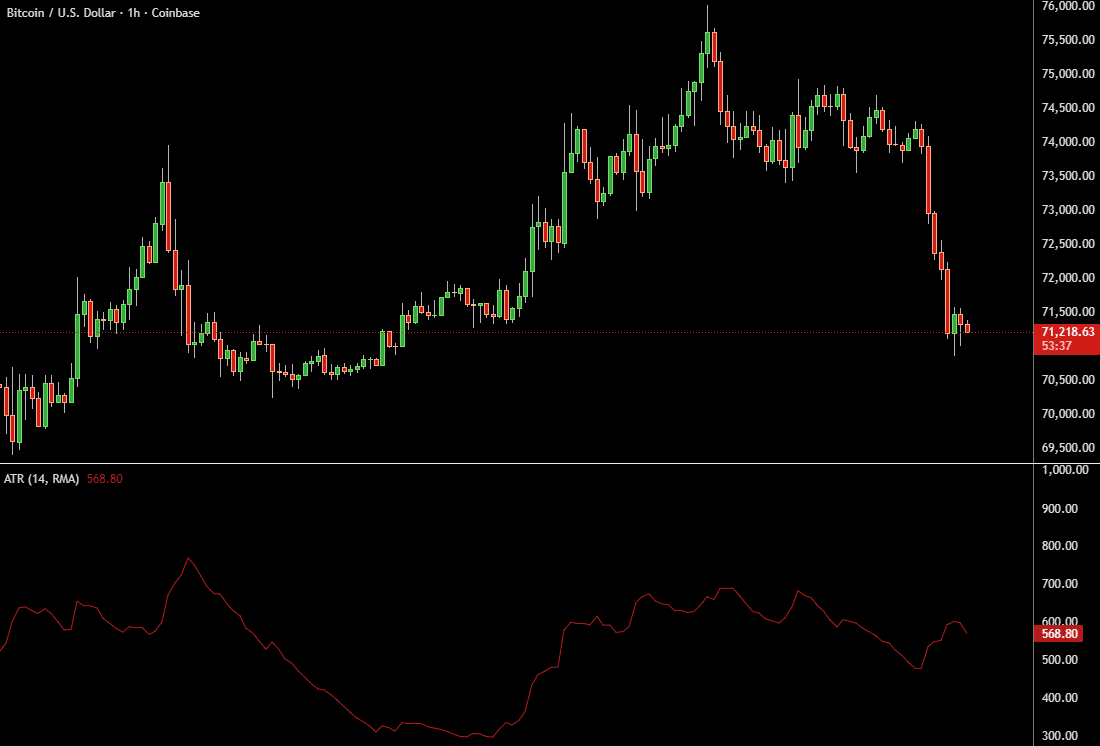
A typical ATR chart view keeps price above and ATR below so traders can compare market movement with current volatility conditions.
ATR does not provide directional bias. It only shows the size of movement, not whether price is likely to rise or fall.
It is most useful as a volatility and risk-management input rather than a standalone trade trigger.
Use this comparison to understand how volatility tools differ from momentum-shift tools.
Review another guide that shows why one indicator alone rarely gives complete context.
Consensus Engine helps keep ATR-like volatility context in perspective by placing it beside trend, momentum, and confirmation tools in one workflow.
That makes volatility readings easier to interpret as part of a full market view rather than as an isolated number.
Consensus Engine keeps trend, momentum, volatility, and participation tools together instead of scattering them across separate views.
M5 through D1 stay visible together, which helps traders compare short-term movement with broader context.
TRUE CVD adds another confirmation layer when traders want more than price-based indicators alone.
ATR measures average price range and is mainly used as a volatility indicator.
No. ATR measures movement size, not bullish or bearish direction.
Because ATR helps with volatility context and risk sizing, but it needs trend or momentum tools for directional context.
Consensus Engine helps traders organize ATR, related indicators, and multi-timeframe context in one structured dashboard.