Type
Trend and momentum indicator
 Consensus Engine
MACD is a trend and momentum indicator used to track directional shifts, momentum transitions, and broader confirmation.
Trend and momentum indicator
Momentum-shift confirmation
Helps identify directional transitions
Can react after price has already moved
MACD compares moving averages to show whether momentum is increasing, decreasing, or shifting direction. It is often used to read transitions rather than just short-term swings.
Because it is derived from moving averages, MACD combines trend and momentum information into one framework.
Traders often use MACD for crossovers, histogram interpretation, and broader momentum confirmation when price is trying to continue or reverse.
It is commonly used alongside indicators like RSI, volume, or Bollinger Bands to judge whether directional momentum is supported by other market conditions.
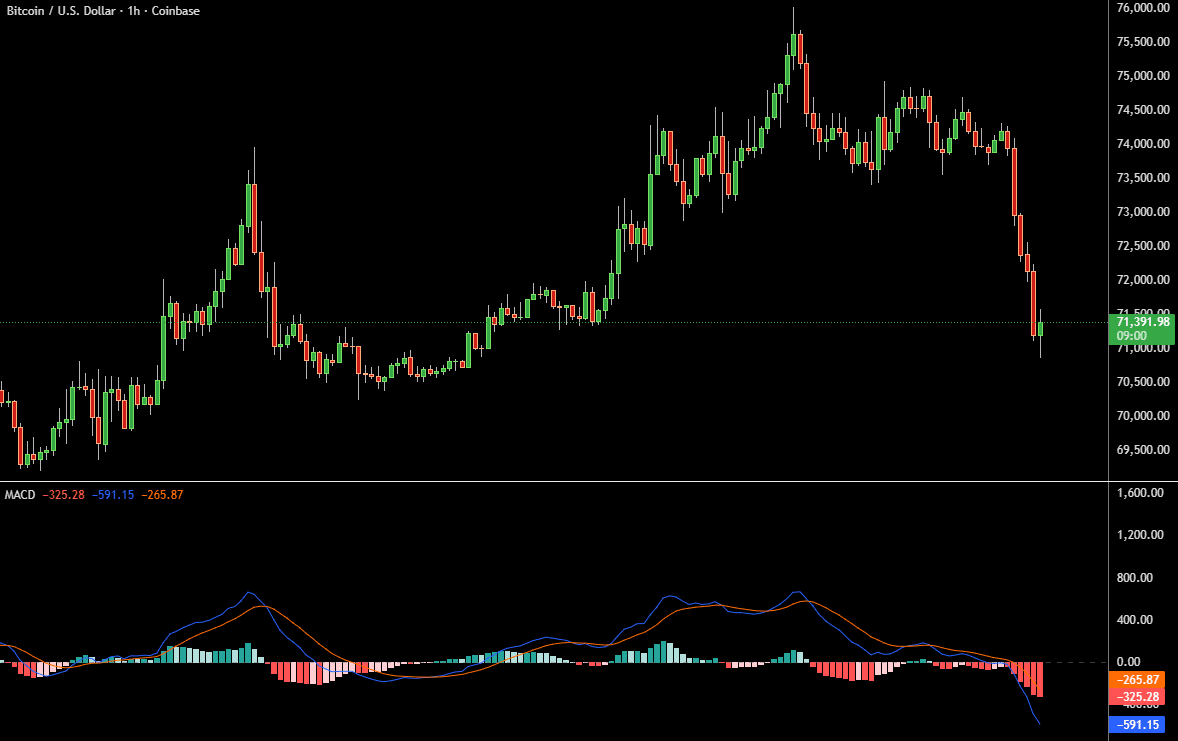
A typical MACD chart view shows price above and the MACD lines below so traders can compare price structure with momentum transitions.
MACD is still based on lagging averages, which means part of a move may already be underway before the signal becomes clear.
It can also become less useful when market conditions are choppy and direction keeps flipping without follow-through.
Compare faster momentum context with broader momentum-shift confirmation.
See how momentum-shift analysis differs from volatility context.
Compare directional momentum analysis with participation confirmation.
Consensus Engine keeps MACD aligned with other indicators so traders can judge whether a momentum transition agrees with broader trend, volatility, and participation signals.
This reduces the need to flip between multiple charts just to confirm whether MACD is standing alone or supported.
Consensus Engine keeps trend, momentum, volatility, and participation tools together instead of scattering them across separate views.
M5 through D1 stay visible together, which helps traders compare short-term movement with broader context.
TRUE CVD adds another confirmation layer when traders want more than price-based indicators alone.
MACD measures momentum shifts and trend-related changes by comparing moving averages.
Yes. MACD is based on moving averages, so it tends to react after price has already begun moving.
Because MACD is more useful when traders can see whether momentum transitions are supported by volatility, participation, or broader context.
Consensus Engine helps traders organize MACD, related indicators, and multi-timeframe context in one structured dashboard.